From Coldwater to Tuscumbia: The Shoals’ First Settlement Story
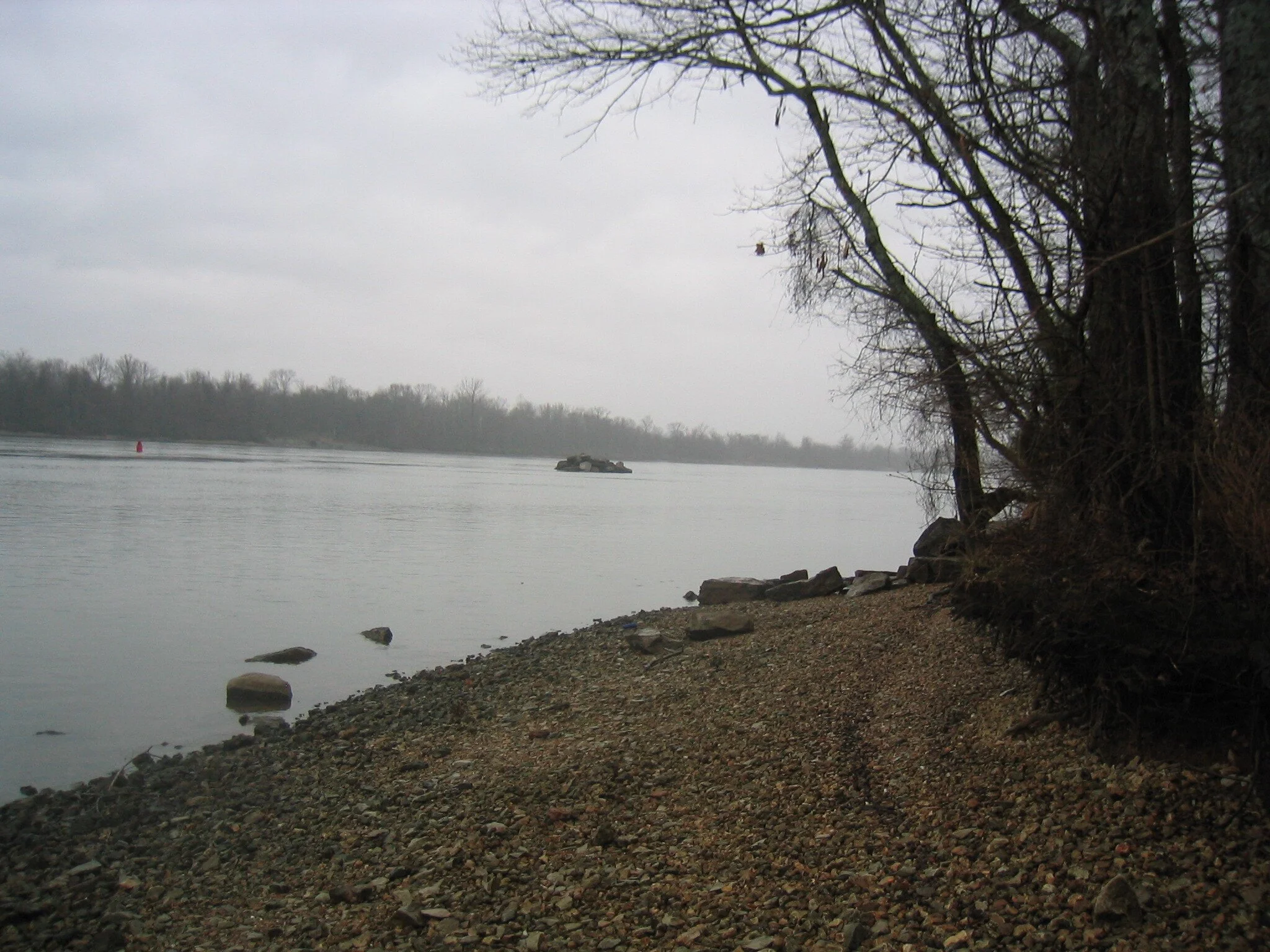
Photo: A foggy morning at Tuscumbia Landing Site near Sheffield, Alabama. National Trails Office, U.S. National Park Service, public domain via Wikimedia Commons.
Before Florence was founded and before Alabama became a state, the Shoals already had a settlement story centered around water, Native homelands, French traders, early roads and the spring that became Tuscumbia.
If you want to understand the early history of the Shoals, you do not start with Florence.
You start across the river, at Coldwater.
Long before the Shoals became known as Florence, Muscle Shoals, Tuscumbia and Sheffield, one of the earliest settlement stories in Northwest Alabama was already taking shape near present-day Spring Park in Tuscumbia.
The place was known by the Chickasaw name Oka Kapassa, also rendered in some sources as Ococoposa, meaning “Cold Water.” The name referred to Spring Creek and the cold spring that became central to Tuscumbia’s identity.[1]
That spring matters. In the early history of almost any place, water tells you where to look first.
A dependable spring meant drinking water. It meant animals could be watered. It meant crops could be grown nearby. It meant people could stop, gather, trade and eventually build.
That is why the early story of Tuscumbia begins not with a courthouse or a city charter, but with a spring.
A Native Place Before It Was an American Town
The Shoals was not empty land waiting to be discovered.
Native people had lived in and moved through the Tennessee Valley for generations before European traders or American settlers arrived. In the historic period, Euro-Americans traveling through the Tennessee Valley primarily encountered the Chickasaw, Cherokee and Creek.[2]
The Chickasaw were especially important in the story of Northwest Alabama. They claimed much of the region that would later become part of the Shoals. The Cherokee also had connections to the broader Tennessee Valley, and the area was shaped by Native trails, hunting grounds, trade routes and diplomacy.
Oka Kapassa was part of that older Native landscape.
To tell the story honestly, we have to begin there. Tuscumbia’s later growth as an American town came on land that already had names, uses and meaning.
The French at Coldwater
The earliest known European settlement in Northwest Alabama appears to have been at Coldwater.
The Muscle Shoals National Heritage Area identifies French settlers near present-day Spring Park in Tuscumbia as the first Europeans to settle in Northwest Alabama. According to that account, French people, along with members of small Creek and Cherokee factions, established the community of Oka Kapassa, or Coldwater, in 1769.[3]
Other local sources vary slightly on the date and description. A Tuscumbia historical marker tradition identifies Oka Kapassa/Ococoposa as a trading post established near the Tennessee River about 1780.[4] The city of Tuscumbia’s own history says the French first settled near the Tennessee River in the 1700s, and that their town was destroyed in 1786.[5]
Those dates do not all line up perfectly, which is common in early frontier history.
But the larger point is consistent: the Coldwater area near present-day Tuscumbia is the strongest candidate for the earliest known European settlement in Northwest Alabama.
This was not a town in the modern sense. It was more likely a small frontier settlement or trading-post community connected to Native life, river travel and regional trade.
But it came first.
The Tennessee River and the Shoals
Coldwater’s importance also came from the larger geography around it.
The Tennessee River was one of the great natural routes of the region. It connected people, trade and territory across what is now North Alabama and beyond. But in the Shoals, the river became difficult.
The Muscle Shoals were a long, shallow, rocky stretch of the Tennessee River. They interrupted navigation and made travel harder. Boats could not simply move through this part of the river the way they could through deeper water.
That barrier shaped the region’s future.
Because the shoals slowed movement, crossings, landings, ferries, trails and roads became more important. People had to figure out where to cross, where to stop, where to trade and where to move around the river’s obstacle.
That is one reason the Shoals became a crossroads.
The river brought people here. The shoals slowed them down. The spring gave them a place to gather.
Roads, Trade and Early American Settlement
By the early 1800s, American settlement pressure was increasing across North Alabama.
The Federal Government built a military road through Tuscumbia between 1817 and 1819, and the city’s history describes that road as the “super highway of its day,” opening the area for trade.[6]
The road mattered because roads turn land into reachable land.
They brought traffic, trade, mail, military movement and settlers. They helped connect springs, ferries, river landings and future towns.
By around 1815, the Michael Dickson family is commonly cited in local histories as among the early American settlers in the Tuscumbia area.[7] They came into a place already shaped by Native history, French presence, the spring, the river and the routes through the Shoals.
The town went through several names. It was associated with Oka Kapassa, Ococoposa, Coldwater and Big Spring before becoming Tuscumbia. According to the city’s history, a vote was taken in 1822 to rename the town either Anniston, after the first white child born in Big Spring, or Tuscumbia, in honor of a Chickasaw chief living there. Tuscumbia won by one vote.[8]
That story, whether read as civic history or local legend, says something about the layered identity of the place.
Tuscumbia was Native, French, frontier, American, spring town and trade town all at once.
Land, Slavery and the Cotton Frontier
The early American settlement of the Shoals also cannot be separated from slavery.
As land opened to American settlement, many newcomers saw the Tennessee Valley as cotton country. Fertile land meant agricultural opportunity, and in early Alabama cotton agriculture was deeply tied to enslaved labor.
Not every early settler was a large planter. The early Shoals included small farmers, merchants, ferrymen, tradesmen, surveyors, speculators and laborers. But the larger economy that developed around land, cotton and wealth-building depended heavily on slavery.
Enslaved Black people cleared land, built structures, worked fields, maintained households and helped create wealth for others.
That history belongs in the story because settlement was not just about roads, springs and town names. It was also about who could own land, who had political power, who was displaced and who was forced to labor without freedom.
Why Tuscumbia Comes First
When we talk about the early settlement of the Shoals, Tuscumbia deserves to come first.
The site around Coldwater/Oka Kapassa had the spring. It had Native significance. It had early French presence. It had American settlement before Florence was founded. It had a military road before Florence became a town.
Florence would soon become one of the most important planned towns in North Alabama.
But the Shoals’ settlement story begins at Coldwater.
Before there was Florence, there was Tuscumbia.
And before there was Tuscumbia, there was Oka Kapassa.
Footnotes
[1] Historical Marker Database, “American Indian History,” Tuscumbia, Alabama.
[2] Muscle Shoals National Heritage Area, “Native American Heritage.”
[3] Muscle Shoals National Heritage Area, “Native American Heritage.”
[4] Historical Marker Database, “American Indian History,” Tuscumbia, Alabama.
[5] City of Tuscumbia, “History.”
[6] City of Tuscumbia, “History.”
[7] City of Tuscumbia, “History.”
[8] City of Tuscumbia, “History.”