The Founding of Florence: How a Planned Town Joined the Shoals Story
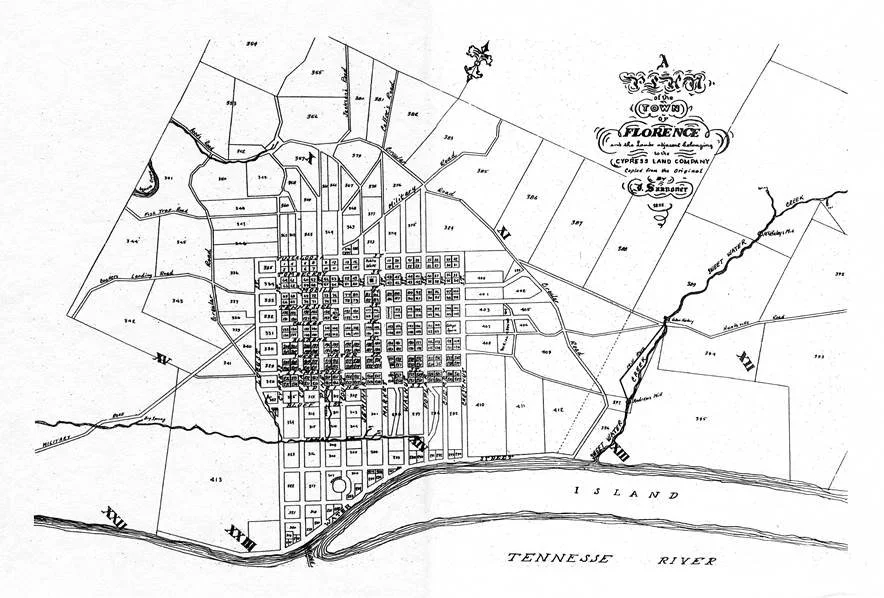
Source: “A Map of the Town of Florence and the Lands Adjacent Belonging to the Cypress Land Company,” University of North Alabama Repository of Alabama Records. Related version: “A plan of the town of Florence and the lands adjacent belonging to the Cypress Land Company, copied from the original by F. Sannoner, 1832,” U.S. Army Corps of Engineers Digital Library.
Florence was not the beginning of the Shoals’ settlement story, but when the Cypress Land Company laid out the town in 1818, it changed the future of Northwest Alabama.
By the time Florence was founded, the Shoals already had a history.
Coldwater, or Oka Kapassa, near present-day Tuscumbia, had already become one of the earliest known European settlement sites in Northwest Alabama. Native people had lived in and moved through the Tennessee Valley for generations. French traders had been connected to the Coldwater area. Roads, river crossings and land cessions were changing the region.
Florence entered that story in 1818.
Unlike Tuscumbia, which grew around a spring and earlier settlement, Florence began as a plan.
It was a real estate vision on a bluff above the Tennessee River.
Chickasaw Land and American Expansion
The land that became Florence was originally part of the Chickasaw Nation.[1]
In the early 19th century, Chickasaw land cessions opened the way for American settlement in what became Northwest Alabama. In September 1816, Andrew Jackson and U.S. commissioners met with Native delegations near Chickasaw leader George Colbert’s trading post and ferry. As a result of treaties signed in September 1816 and others in May 1817, much of Northwest Alabama was opened for development and settlement.[2]
That process is central to Florence’s founding.
For land companies and American settlers, the opening of land meant opportunity. For Native people, it meant the loss of land, authority and security.
Florence was built inside that larger story of expansion and dispossession.
Roads, Rivers and the Promise of a Town
The founders of Florence saw geography as opportunity.
The Tennessee River was nearby. The Muscle Shoals made navigation difficult, which increased the importance of surrounding roads, crossings and high ground. Jackson’s Military Road helped bring more settlers into Alabama and helped open settlement on both sides of the Tennessee River.[3]
Florence’s site had something early town builders wanted: elevation.
The town was laid out on a hill overlooking the Tennessee River. That high ground made the location attractive because people believed it would help them avoid diseases associated with lower elevations along the river.[4]
The founders also believed the town’s position near the river and the shoals could make it a major commercial center.
That was the dream: a planned town, high above the river, positioned to benefit from trade, settlement and future growth.
The Cypress Land Company
In March 1818, Gen. John Coffee and other investors in the Cypress Land Company purchased the land that became Florence.[5]
The company included some of the most powerful and ambitious men connected to early North Alabama development. Names associated with the Cypress Land Company include John Coffee, Andrew Jackson, Thomas Bibb and John McKinley.[6]
Other sources also connect men such as James Jackson to the company’s leadership and the founding of Florence.[7]
This was not a settlement that simply grew by accident. Florence was organized, surveyed, promoted and sold.
In plain terms, Florence began as early land development.
As a Realtor, I find that part fascinating. The town’s founders were thinking about location, access, value, future growth and public confidence. Those same ideas still shape real estate today, even though the world around them has changed completely.
John Coffee and Ferdinand Sannoner
Two names sit at the center of Florence’s founding: John Coffee and Ferdinand Sannoner.
John Coffee was a military figure, surveyor, land speculator and close associate of Andrew Jackson. After visiting Northwest Alabama in 1817, Jackson, Coffee and other investors formed the Cypress Land Company in 1818 to organize settlement in what would become Florence.[8]
Coffee commissioned Ferdinand Sannoner, an Italian engineer and surveyor, to survey the land.
Sannoner was born in Leghorn, Italy, now commonly known as Livorno, in 1793. He graduated from the French Polytechnic Institute in Paris, worked as a surveyor for Napoleon and came to America around 1816. In 1818, Coffee appointed him to survey the area that would become Florence. Sannoner completed the survey and drew the town plan.[9]
According to the Encyclopedia of Alabama, Coffee was so pleased with Sannoner’s work that he asked him to name the town. Sannoner chose Florence, after his home in Italy.[10]
That gives Florence one of the most distinctive founding stories in Alabama: a North Alabama town on the Tennessee River named by an Italian surveyor for Florence, Italy.
Florence Is Established
Florence was established on March 12, 1818.[11]
At that time, Alabama was still a territory. Statehood would not come until December 1819.
Florence immediately became the county seat of Lauderdale County, though the city was not officially incorporated until 1826.[12] Lauderdale County itself was created in 1818 and named for Col. James Lauderdale, a Tennessee officer who died during the War of 1812.[13]
Becoming the county seat gave Florence an immediate advantage.
County seats brought courts, lawyers, records, land transactions, public business, hotels, stores and regular traffic. They helped a town become more than a collection of lots.
For Florence, that role mattered from the start.
Land Sales and Early Ambition
The first public land sale in Florence was held in July 1818, with another sale in 1823. Records show that 180 people, including Andrew Jackson, acquired lots after those two sales.[14]
The Cypress Land Company expected Florence to become a major commercial town because of its location on a hill overlooking the Tennessee River.[15]
Florence did become an important industrial, agricultural and commercial center, but it did not grow as dramatically as its founders had hoped.[16]
That is one of the honest lessons in the town’s founding.
Florence began with big ambition. Some of that ambition came true. Some did not. But the planned town endured and became one of the anchors of the Shoals.
Slavery and the Early Town
Florence’s founding also belonged to the world of early Alabama: land speculation, cotton agriculture and slavery.
As American settlers moved into Northwest Alabama, many saw the Tennessee Valley as cotton country. Land became valuable not only because of its location, but because of what could be grown on it and what wealth could be built from it.
That wealth was often tied to enslaved labor.
Enslaved Black people cleared land, worked fields, built structures, maintained households and helped create the economy that supported early towns and farms across Alabama.
So when we talk about Florence as a planned town and early real estate venture, we also have to remember the harder truth of the period: legal property ownership, political power and economic opportunity were not shared equally. Native people were being dispossessed. Enslaved people were being forced to labor. White settlers and speculators were building wealth from land and labor systems that excluded and exploited others.
Florence’s founding is a story of planning and ambition.
It is also part of that larger, complicated history.
Florence Joins the Shoals Story
Florence was not the first settlement in the Shoals.
Coldwater came first. Tuscumbia’s spring, Native history and early French presence give that side of the river the earliest settlement claim.
But Florence quickly became one of the most important towns in Northwest Alabama.
It was planned by the Cypress Land Company. It was surveyed by Ferdinand Sannoner. It was promoted as a town with commercial promise. It became the county seat of Lauderdale County. And it grew on high ground overlooking the Tennessee River.
Florence did not begin the Shoals story.
It joined it.
And in 1818, it changed the map.
Footnotes
[1] Encyclopedia of Alabama, “Florence.”
[2] Encyclopedia of Alabama, “Jackson’s Military Road.”
[3] Encyclopedia of Alabama, “Jackson’s Military Road.”
[4] Encyclopedia of Alabama, “Florence.”
[5] Encyclopedia of Alabama, “John Coffee.”
[6] Encyclopedia of Alabama, “John Coffee”; Encyclopedia of Alabama, “John McKinley.”
[7] Encyclopedia of Alabama, “James Jackson.”
[8] Encyclopedia of Alabama, “Jackson’s Military Road.”
[9] Auburn University Omeka, “Ferdinand Sannoner.”
[10] Encyclopedia of Alabama, “Florence.”
[11] Encyclopedia of Alabama, “Florence.”
[12] Encyclopedia of Alabama, “Florence.”
[13] Encyclopedia of Alabama, “Florence”; Lauderdale County historical references.
[14] Encyclopedia of Alabama, “Florence.”
[15] Encyclopedia of Alabama, “Florence.”
[16] Encyclopedia of Alabama, “Florence.”
Benjamin Newbern is a licensed REALTOR® with CRC Realty in Florence, Alabama, serving buyers and sellers throughout the Shoals. AL License #000169445.